VIDEO | BAFT’s Strategic Independence in an Era of Geopolitical Complexity

Via Trade Finance Global by Tod Burwell, Mahika Ravi Shankar, and Suresh Subramanian

Try to conceptualise the financial landscape of 1921. In the direct aftermath of the First World War, many European economies were burdened by war debts and reparations, particularly Germany under the Treaty of Versailles; the US emerged as the world’s leading creditor nation, shifting the financial centre of gravity from London to New York; global trade and investment were disrupted; and the gold standard, though still influential, was under strain as countries struggled to stabilise their currencies.

Also in 1921, the Bankers’ Association for Finance and Trade (BAFT) was established, uniting 10 banks in midwestern US to expedite business transactions of their international trade customers.

After more than two decades under the American Bankers Association (ABA) umbrella, the Bankers’ Association for Finance and Trade (BAFT) is charting a new course as an independent organisation. The separation, effective September 2025, will be in response to an increasingly fragmented global financial landscape.

“When we started talking about this separation, some maybe 30 months ago, we looked at it from a theoretical construct. The events of today tell us how right we were,” explained Suresh Subramanian, outgoing BAFT Chair, in the opening remarks of the BAFT 2025 Global Annual Meeting in Washington, DC. With 70% of BAFT’s membership coming from international institutions, the need for geopolitical neutrality has become paramount.

Neutrality in a polarised world

The challenge was clear: how can an organisation truly serve global banking interests while remaining a subsidiary of an association chartered specifically for US banks? The ABA, by design, focuses on US-chartered institutions. For BAFT to maintain credibility as a neutral voice in international trade finance, independence became not just desirable but essential.

BAFT is expanding its engagement beyond traditional boundaries, recently electing its first Americas Council co-chair from Mexico’s Banorte—the first time this position has been held by someone outside the US or Canada. These partnerships mirror broader industry trends toward collaboration in an increasingly complex environment. Just as Swift works with banking associations worldwide to navigate regulatory frameworks while maintaining global connectivity, BAFT is positioning itself to serve as an independent bridge between diverse financial jurisdictions. Local partnerships will enable BAFT to provide more relevant, jurisdiction-specific support while maintaining its global perspective.

Managing transition risks

The separation won’t be without challenges. Moving from the infrastructure support of a large, well-funded parent organisation requires significant operational restructuring. All HR, finance, IT, and customer systems must be migrated to new platforms—a complex undertaking that could disrupt member services if not executed flawlessly.

The re-onboarding requirements that many member organisations will face represent perhaps the biggest immediate challenge. As banking institutions implement increasingly stringent vendor management processes, BAFT’s change in legal structure may trigger lengthy approval procedures, so the organisation is actively working with members to streamline this process, emphasising continuity despite structural changes.

As Tod Burwell, President and CEO of BAFT and Trade Finance Global (TFG) Editorial Board Member, emphasised, operational continuity in the transition will be important.

BAFT’s upcoming independence reflects broader themes reshaping international finance: as geopolitical tensions intensify and regulatory frameworks diverge, financial organisations must balance global reach with local relevance. The ability to maintain neutrality while serving diverse stakeholders becomes increasingly rare and thereby increasingly valuable.

Strategic independence doesn’t mean isolation—it means having the flexibility to build the partnerships that best serve members’ evolving needs, and also stands as an experiment in organisational agility.

The separation from ABA was conducted on amicable terms, with expectations of continued collaboration where beneficial. 
Via Global Trade Review by John Basquill

New York legislators have taken an important step towards digitalising trade in the state, adopting reforms that provide a legal basis for electronic records and digital assets. 

Adopted by the Assembly and Senate on June 11, the reforms bring New York in line with the Uniform Commercial Code (UCC), a model law amended in 2022 to incorporate digital trade documents and other emerging technologies. They will become law once the amending bill is signed by Governor Kathy Hochul. 

Electronic bills of lading have been recognised as title documents in New York since 2014, but the latest reforms are broader in scope, applying to electronic versions of negotiable instruments and digital assets. 

GTR speaks to Tod Burwell, president and chief executive of Baft (Bankers Association for Finance and Trade), about the background to the reforms, the role of the association in bringing about change, and what the new-look legal framework means for US digital trade. 


GTR: What is the background to these reforms, and Baft’s role in helping bring them about? 

Burwell: The broader effort to provide a legal framework for digital trade originated around seven years ago, and we wrote a paper on the subject in 2018 called Code Is Not Law. At that time, there was a lot of energy around the use of blockchain as a vehicle to transform how trade could happen in the future. The paper essentially said that you need to adjust the legal framework and not just the technological capability to do trade digitally. 

Interestingly, the UNCITRAL Model Law on Electronic Transferable Records (MLETR) was published around that same time, and what we then started to see was the socialisation of that model law, and countries trying to incorporate those elements into their legal frameworks. There were a few early adopters, but the really large trade jurisdictions were a bit further behind in getting that going. 

In terms of Baft’s engagement, the International Chamber of Commerce convened a variety of stakeholders across the globe to structure a group called the Legal Reform Advisory Board. We would meet periodically to target jurisdictions where we feel we can move the needle, and for Baft, it was natural for us to be designated to drive efforts in the US. 


GTR: What is different about the US market compared to jurisdictions that have already fully adopted digital trade laws? 

Burwell: In some jurisdictions, it is easier to take a national approach, but the complication with the UCC is that changes have to be adopted state by state. There is no single step the federal government can take to switch from analogue today to digital tomorrow. 

Also, because legal frameworks are different across jurisdictions, you couldn’t just take MLETR and slot it into US law. The way it worked in the US was the Uniform Law Commission passed amendments in 2022, and from there the process started to drive this through the individual states. 

On Baft’s side, we have been highly engaged with the Uniform Law Commission and the bar associations that drafted the amendments to the UCC that would, in effect, accomplish what the MLETR framework was intending to do. 


GTR: What is state-by-state adoption like looking now, and how significant is it that New York has reached this milestone? 

Burwell: So far, there are 30 states that have adopted the changes to the UCC into law, and there are eight states – technically including New York, as we still have to wait for the Governor to put her signature on the bill – that are somewhere in the process.  

We still have some work to do in the major land port border states, like Texas and Michigan. But nine of the 10 largest seaports in the US are now governed by laws that support digital trade, and most of the international trade traffic tends to come through West Coast ports that are in states that have already adopted the UCC amendments. 

In that context, the big one from the US perspective was to get New York across the finish line. Within the US, the volume of trade that is subject to New York law is pretty substantive. 

One of the nuances with the UCC is that one state’s version will not be the same as the others. To give an example, the electronic bill of lading has been in place in New York for some time, but other forms of negotiable instruments still require paper evidence of ownership.  

One of the other nuances with the New York structure and framework is that it is a little more forward-looking in that it incorporates elements of how digital assets should be treated. The MLETR framework doesn’t really get into that, but in the UCC amendments, we’re trying to account for more than just digital documents. 


GTR: Has there been much impact so far in states that have introduced these changes, or is it still too early to see the benefits? 

Burwell: It’s still very early days. Getting the legal framework in place is an important milestone because that enables commercial parties to move forward more assertively with digitalising their processes. If you know that a digital version of an instrument is not legally enforceable, you might not make the investment necessary to be able to transact in that form.  

Now, this opens the window for organisations to push forward on some of those investments, and for the ones that have already done that, it enables them to progress with live electronic end-to-end transactions. 

On May 12, 2025, BAFT responded to the Office of Management and Budget’s (OMB) request for information regarding Deregulation.

Click below to read the comment letter in its entirety.

READ MORE HERE >

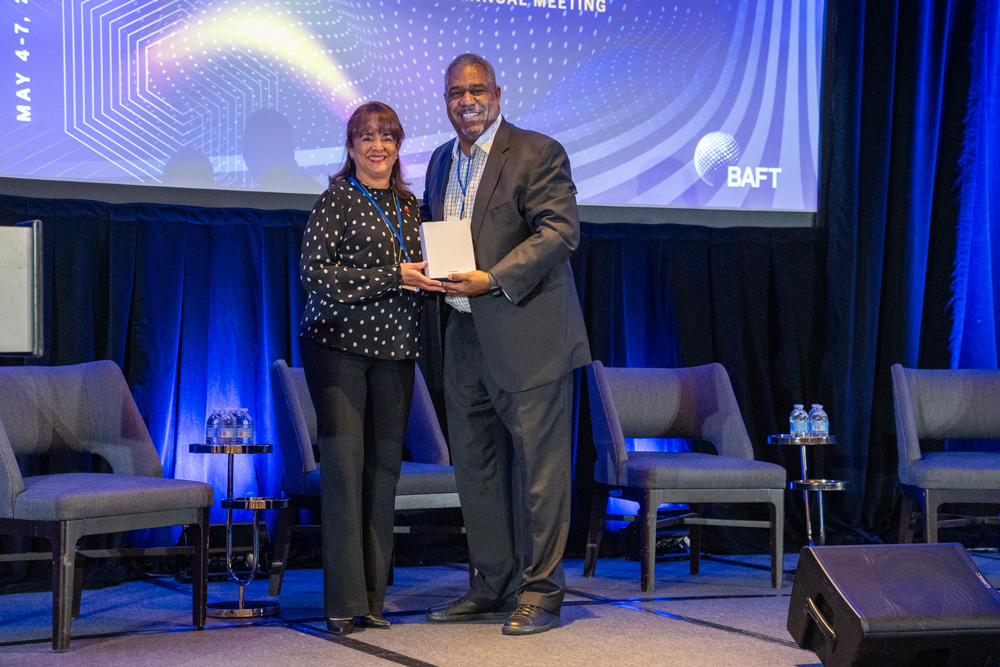
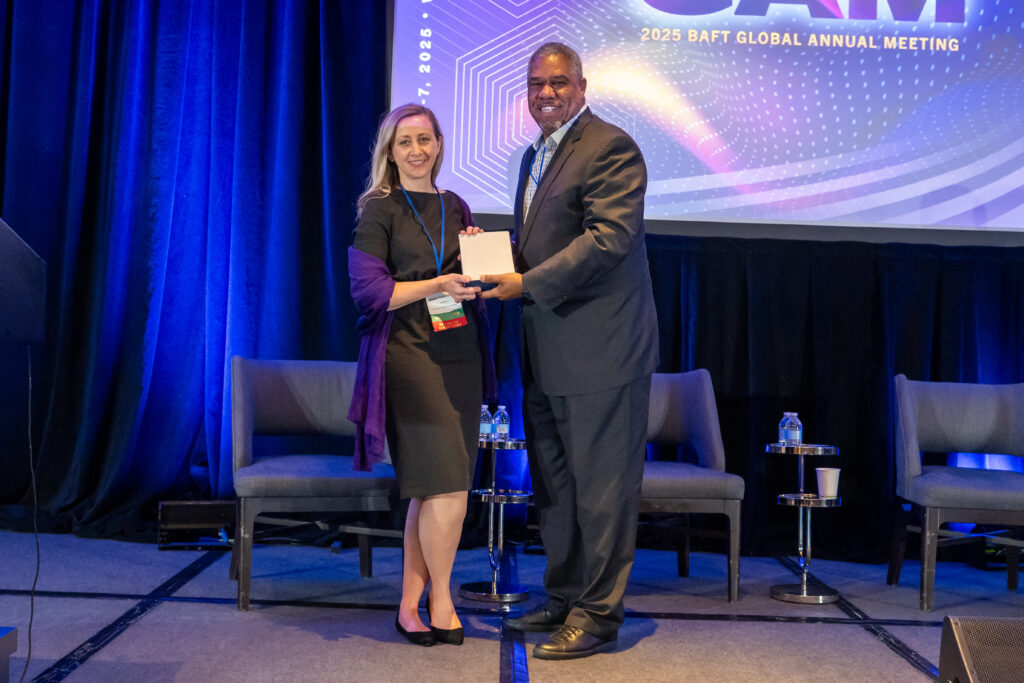
Announced at the 2025 Global Annual Meeting in Washington, DC on May 6, BAFT is proud to recognize the following individuals for their outstanding contributions to the association over the past year.

  • Miriam Ratkovicova, Managing Director, Deloitte Transactions and Business Analytics, LLP
  • Emy Ruiz, SVP, Head of Global Transaction Banking, Fifth Third Bank

BAFT honors members who have generously volunteered their time and expertise to support the association’s mission and continue to drive the vision forward. Selected through a staff-led voting process, the BAFT Ambassador of the Year Award celebrates those who have made a significant impact on the association in 2025. The awards were presented during the BAFT Global Annual Meeting.

Miriam Ratkovicova
Emy Ruiz

WASHINGTON – BAFT, the leading global financial services association for international transaction banking, today announced the graduates of its Future Leaders program class of 2025. The program – now completing its 10th year – recognizes upcoming leaders in the global transaction banking industry. The Future Leader graduates were honored at an in-person ceremony in Washington, D.C. on May 6 as part of BAFT’s 2025 Global Annual Meeting.

Nominated by their respective institutions, the class of 2025 included 40 individuals from 17 countries across the Americas, Europe, Asia, MENA and Africa, representing a variety of disciplines within transaction banking. The class of 2025 was divided into five project teams tasked with addressing current industry issues, including artificial intelligence threats for trade finance fraud, accelerating cross-border real-time payments across major corridors, BRICS, operating model for corresponding banking, and an update on the almost 300 graduates from the program.

“This program has exceeded our expectations when we started it 10 years ago,” said Tod Burwell, BAFT president and CEO. “I continue to be impressed with the caliber of participants and value of their work.  Congratulations to this year’s class for extending the traditions.”

BAFT congratulates the following graduates from the class of 2025:

  • Elif Seray Akin, ING Bank
  • Adel AlZarooni, First Abu Dhabi Bank (FAB)
  • Mafalda Arnaud, Société Générale
  • Viktor Bakkioui, Skandinaviska Enskilda Banken (SEB)
  • Ayush Bhandari, Crown Agents Bank
  • Peyton Boles, First-Citizens Bank
  • Daranee Bolger, NatWest
  • Saad Chemseddine, BNP Paribas
  • Kevin Chu, RBC Capital Markets (Royal Bank of Canada)
  • Maximillian Chua, Standard Chartered Bank
  • James Deneault, TD Securities
  • Olivia Ellis, BNP Paribas
  • Laura Ernst, StoneX
  • Serena Fazzini, UniCredit
  • Harrison Gutman, PNC Bank
  • Gentiana Halimi, Banka Kombetare Tregtare Kosove
  • Jeronimo Hernandez, Bank of America
  • Ajay Joshi, Credit Agricole Corporate & Investment Bank
  • Tina Kim, JPMorgan Chase Bank
  • Srushthi Kshirsagar, ANZ Bank
  • Tapiwa Kuipa, African Export-Import Bank (Afreximbank)
  • Carmen Landeras Cabrero, Santander Corporate & Investment Banking
  • Audrey Lees, HSBC Bank
  • Xiaosu (Charles) Liang, American International Group (AIG)
  • Yuriy Lobanov, Commerzbank
  • Carlos Martínez Illán, Banco Bilbao Vizcaya Argentaria (BBVA)
  • Wan Chung Arick Ng, Bank of America
  • Awuzhaer Nijiati, ING Bank
  • Abigale Ning, Standard Chartered Bank
  • Oskar Nordlander, Skandinaviska Enskilda Banken (SEB)
  • Álvaro Ocampo, Banorte (Banco Mercantil del Norte)
  • Israel Ortigas, Bank of New York
  • Heidi Pun, ANZ Bank
  • Carmen Maria Ramirez Ortiz, Asian Development Bank
  • William Rattray, JPMorgan Chase Bank
  • Renan Reinoso, SMBC
  • Erik Rost, Citi
  • Elena Rozas, Santander Corporate & Investment Banking
  • Christopher Selfe, Barclays
  • Yang Wu, Bank of China

The whitepapers from each project team are available for members to download for free by the end of May, and a series of webinars on each project will run in June.

About BAFT

BAFT, the leading global financial services association for international transaction banking, helps bridge solutions across financial institutions, service providers and the regulatory community that promote sound financial practices enabling innovation, efficiency, and commercial growth. BAFT engages on a wide range of topics affecting transaction banking, including trade finance, payments, and compliance. The association website is www.baft.org.

Via Global Trade Review by Shannon Manders

Baft (Bankers Association for Finance and Trade) has appointed Nick Smit, global head of financial institutions banks at ING, as chair of its board of directors for the 2025-26 association year. He succeeds Suresh Subramanian, head of North America for transaction banking at BNP Paribas, who has served as chair since 2023 and oversaw the initial phases of Baft’s transition to become an independent organisation.

Smit takes over as Baft prepares to formally separate from the American Bankers Association (ABA), effective September 1, 2025. The two organisations first announced their intention to part ways in January, citing Baft’s increasingly global footprint and the need for greater strategic alignment with its international membership.

“I really appreciate this vote of confidence by the Baft community,” says Smit in a release. “Baft has grown into the leading global organisational forum for not only trade, but payments and cash management, and working capital solutions, too. I am very much looking forward to continuing the good work done in the past as we operate and grow further as an independent organisation in the future.”

Based in New York, Smit leads ING’s global relationship management team covering US, Canada, Latin America and global banks. He brings over 30 years of international banking experience and has served on Baft’s board since 2022.

Speaking at Baft’s annual general meeting in Washington, DC, on May 5, president and CEO Tod Burwell reflected on the rationale behind the separation: “The ABA is designed to focus on US charter banks. Baft’s membership is 70% international. If you have to have neutrality from a geopolitical perspective, it is complicated to be a subsidiary of the ABA and play that role without compromising the ABA’s position.”

Also speaking at the event, Subramanian noted the extensive preparation undertaken to ensure a smooth transition: “The last two years have perhaps been the most active period for the Baft board and executive committee. A lot of heavy lifting has taken place, not only to strengthen the financial position, but also to get the pieces needed so that the transition is as seamless as possible.”

The association has stated that its core focus on advocacy, education, thought leadership and industry collaboration will remain unchanged.

“The independence affords the Baft board and membership the ability to chart a path for growth and set our own direction on the topics that matter most to our community,” Subramanian added.

Smit will be joined by re-elected officers Michelle Knowles, head of trade and working capital of Absa, as vice-chair and Miriam Ratkovicova, managing director in the anti-money laundering economic and trade sanctions practice of Deloitte, as secretary/treasurer.

The board also includes a group of senior leaders from banks, fintechs and other financial institutions across multiple regions.