

Where MENA’s Transaction Banking Community Connects
The MENA region is playing an increasingly important role in global trade, payments and investment. As economic relationships shift, new technologies emerge and regional connectivity expands, financial institutions are navigating both new opportunities and growing complexity.The 2027 BAFT MENA Forum brings together transaction banking leaders from across the region and around the world to examine the forces reshaping the industry and what they mean for financial institutions and their clients.
Through candid discussions, practical insights and regional perspectives, the Forum will explore the economic, geopolitical, technological and regulatory developments influencing transaction banking across MENA. Discussions will consider how the industry is responding to changing client expectations, evolving business models, new technologies and shifting global and regional dynamics, while identifying opportunities for greater connectivity, innovation and growth.
Join your peers in Dubai to exchange ideas, strengthen relationships and explore how banks and other transaction banking stakeholders can compete, collaborate, and grow as MENA’s role in the global financial system continues to evolve.
Join us in Dubai, January 26-27
The 2026 MENA Forum at a Glance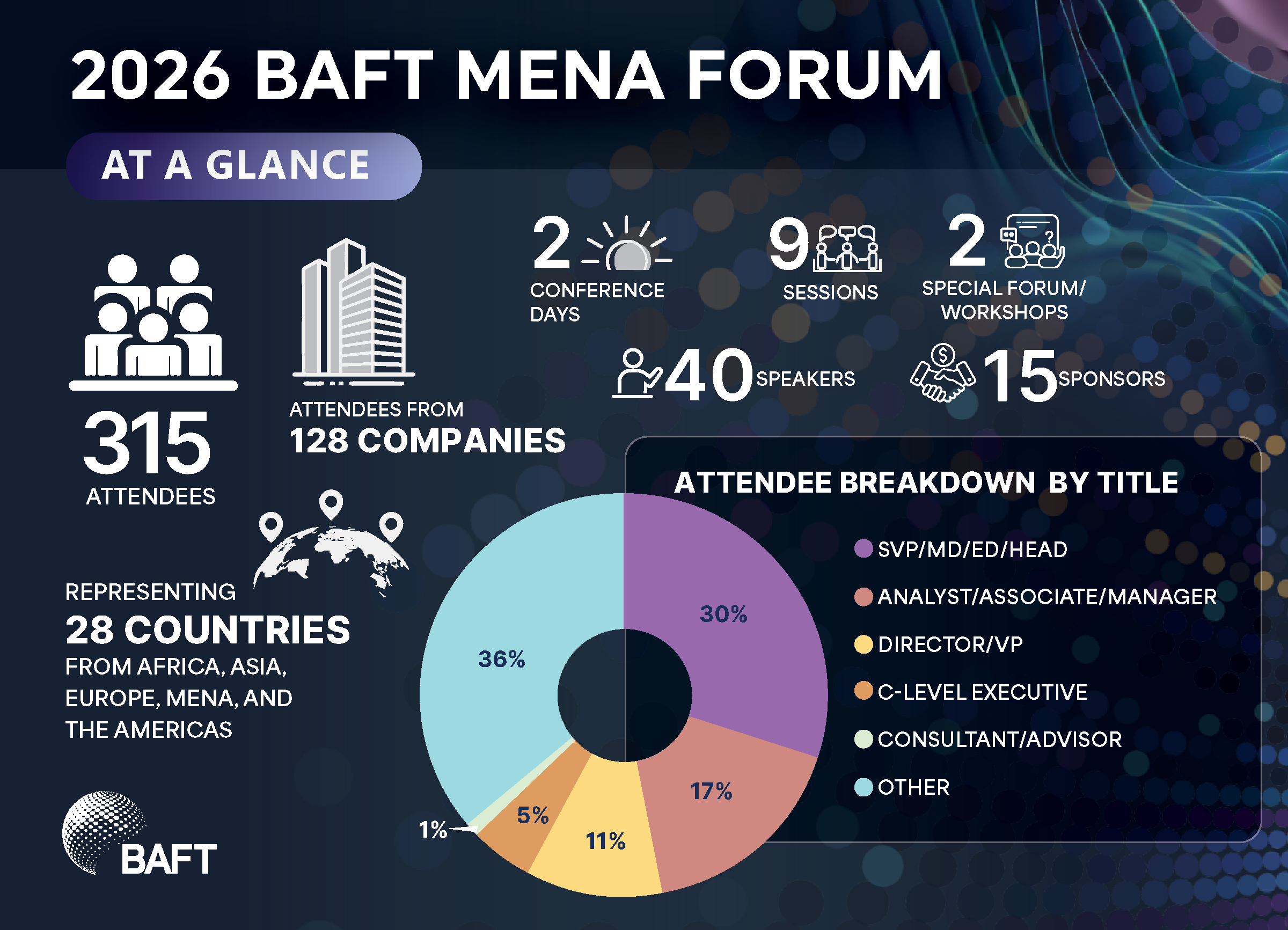
The Call for Speakers is now closed.
Due to the anticipated volume of submissions, only selected speakers will be contacted. Notifications will be sent by the end of November 2026. We appreciate your patience as the program planning committee carefully reviews each submission and evaluates its fit with the overall program.
9:00 – 12:30
12:30 – 13:30
13:30 – 18:30
17:30 – 18:30
8:00 – 9:30
9:30 – 12:30
12:30 – 13:30
13:30 – 15:00
This Forum is open to all attendees, regardless of gender, and included in your conference registration.
13:30 – 17:00
15:00 – 17:00
| Registration Type | Early Bird Rate Until November 13 |
Regular Rate November 13 – December 31 |
Last Minute Rate After December 31 |
| Member | $550 | $675 | $800 |
| Non-Member | $750 | $875 | $1,000 |
Member Pricing
Non-Member Pricing
Special Group Rate: Groups of six or more, including team members and clients, who register at the same time at the full conference rate may be eligible for a group discount. Contact [email protected] for additional information.
Please Note: You will be asked to log in to your BAFT web account to complete registration. If you have not reset your PW or created a BAFT account, please complete this step before proceeding with your registration.

Tod Burwell is the President and Chief Executive Officer of BAFT. Prior to being promoted to CEO, he served as the Senior Vice President of Trade Products with oversight of all trade-related initiatives including the Global Trade Industry Council, Trade Committees, and other strategic initiatives of the organization. Mr. Burwell has over 25 years of trade, supply chain and cash management experience as a banking practitioner, as well as serving as a consultant to global corporations and suppliers of strategically integrated trade solutions. Prior to joining BAFT, Mr. Burwell was a Managing Director at JPMorgan Chase and held senior global management roles responsible for trade operations, launching the logistics business and managing global product sales for trade finance and logistics management.
Join the transaction banking community along with others involved in cross-border payments and trade as they gather to discuss key issues and best practices at the 2027 BAFT MENA Forum. The MENA Forum is your opportunity to position your organization as a thought leader and connect with your clients. Plus, network with your colleagues or hold uninterrupted meetings with prospective and future clients during dedicated bilateral meeting sessions built into the program schedule.
SOLD OUT (First Abu Dhabi Bank)
2 Available (Arab Bank, Marex)
3 Available (Mashreq, StoneX)
6 Available (SocGen)
1 Available
2 Available
1 Available
1 Available
1 Available
2 Available
1 Available
SOLD OUT (First Abu Dhabi Bank)
1 Available
1 Available
1 Available
4 Available
Venue and Accommodations
The 2027 BAFT MENA Forum will be held at the Embassy Suites in Dubai’s Business Bay.
 Embassy Suites by Hilton Dubai Business Bay
Marasi Drive, Business Bay | Dubai UAE | (Google Map)
Book Your Room
A special block of rooms at the Hilton Garden Inn Dubai Business Bay (connected to the Embassy Suites) have been reserved exclusively for BAFT conference attendees. These block of rooms often sell out, so book early to guarantee your room at the discounted attendee rate.
Hilton Garden Inn Dubai Business Bay: Starting at USD $322*
*Limited availability, rate is inclusive of breakfast & tax
Book your room by completing the hotel reservation form and send an email to [email protected].
Airport Transfers
BAFT has also arranged airport transfers for your convenience at USD $60 each way, up to 3 adults per car. Complete the hotel reservation form to reserve your airport transfers.






Interested in sponsoring the 2027 MENA Forum? We can tailor your sponsorship package to meet your goals.
To discuss your sponsorship options, please contact:
Matthew Kaitz
Head of Business Development
[email protected]
+1 (703) 200-9071